
Navajo Country Part One – Beyond the Mature Living article.
I wrote two articles on Navajo Country for the October and November, 2015 issues of Mature Living magazine.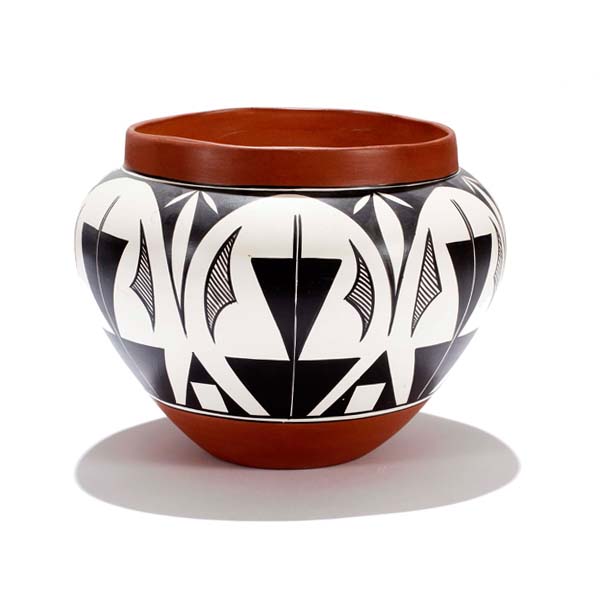 Length restrictions preclude a more extensive examination of the area and its people. This page is intended to be a supplement to the article. However, even if you did not read the article, I hope to entice you to continue reading this supplement about this interesting native American nation. NR
The taciturn and reticent Navajo make it difficult for strangers to get to know them, and therefore their intricate culture and historic struggles. Curiosity characterized my first encounter with the Navajo. The first sight of them lining the sidewalk with their handcrafts in front of the Governor’s Palace on the Plaza in Santa Fe, is one of those pictures etched indelibly in my memory. This image was reinforced dozens of times during my many visits to the city. Their stoic, weather etched, craggy faces seemed to silently project lives of determined survival in a world prescribed and defined by forces beyond their control.
The author, Tony Hillerman, was one of the few outsiders to be accepted and trusted with the secrets of Navajo culture, customs, superstitions and religion. His books, Thief of Time, Skinwalkers, The Blessing Way and others, created a fascination that led me to plan group tour itineraries to New Mexico and Arizona to gain at least a superficial introduction to the Navajo society. These motor coach tours were some of the most popular and significant itineraries that we offered.
As knowledge of their contribution to the war of the Pacific during World War II spread after declassification, public acclaim elevated them to hero status. The “Navajo Code Talkers” developed a system of secret military communication based upon the their complex language. The code was never broken and played an essential role in several famous battles in the Pacific Theater. I have included links below to articles about the Code Talkers. Read some of them and you will doubtless be fascinated and gain a greater appreciation for the men who volunteered to serve in this capacity.
“The Long Walk”
We like to begin an introduction to the Navajo by visiting the site of Bosque Redondo, just outside Fort Sumner, on US 84 highway in eastern New Mexico. The Memorial to the Navajo and Apache, chronicles one of the many chapters in the abominable treatment of native Americans by the United States government in the 19th century.
For unrecorded centuries, the Navajo thrived on land enclosed by their sacred mountains in what is now Arizona. Completely disregarding their historic claim to the land, bloody raids by Mexican settlers and the United States Army, motivated the Navajo to fight back. In typical Federal disdain during the 1800s, Washington decided to relocate the worrisome Indians. Kit Carson rounded them up and march them 300 miles to Bosque Redondo in 1864. More than a third of the 9,000 who began the walk, died on the way and once there, uninhabitable conditions caused the deaths of hundreds more. Crops failed and the water from the Pecos river caused them intestinal problems. Army food, foreign to their normal diet, also contributed to the deterioration of their health. Four years later the survivors were allowed to return to their ancestral lands.
Fort Sumner is also the burial place for Billy the Kid, the legendary outlaw. A Billy the Kid Museum on US 84 is worth a visit. His life story is a series of narrow escapes and suspenseful episodes. I have written about him in another article posted on this website. It is a fascinating tale. I had fun each morning of the Navajo tour relating an episode in the life of Billy the Kid, ending in a cliff hanger. Passengers seemed to enjoy each chapter and anticipated what would happen next.
Santa Fe
Continue west from Fort Sumner on US 84 to I-40, then west to US 285 at Clines Corner. Turn north toward Santa Fe. Conclude the drive to the city on south I-25.
Many visitors from east of the Mississippi river, accustomed to being enclosed by trees, find the desert Southwest a little disconcerting and not at all attractive, but given time, the quiet tranquility of the open vistas and the soaring Sangre de Christo mountains, become seductive. I visited Santa Fe an average of once a year for more than twenty five years, and the appeal of New Mexico and Arizona grew with every visit. New Mexico’s motto, “Land of Enchantment,” is absolutely true.
Traveling from east to west, Santa Fe will be the first real introduction to southwestern American Indians. Entering Santa Fe, the brown adobe buildings announce that we are now in Indian country. The buildings create a visual concept of another time and culture. The capital of New Mexico is one of America’s most unique, historic and beguiling cities. Its small size makes it easy and delightful to explore.
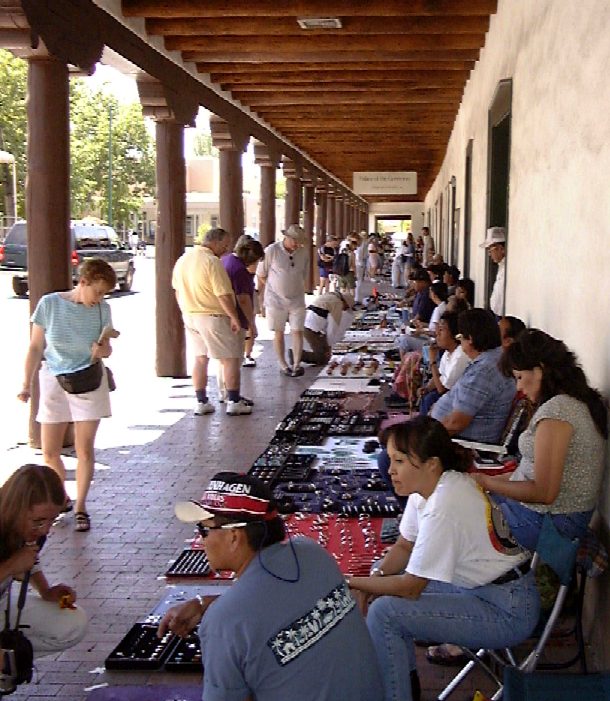 “We begin our visit at the downtown Plaza. Stores line three sides of the small park. The Palace of the Governors occupies most of the north side of the Plaza. This adobe structure was built in 1610 as the seat of the Spanish government. It is the oldest continuously occupied public building in the United States, and now houses the state’s History museum. Each day Navajos spread their blankets or cloths along the sidewalk in front of the Palace to display their handcrafts for sale.” — “Navajo Country Part I,” by Norman Rodgers used by permission from “Mature Living” magazine.
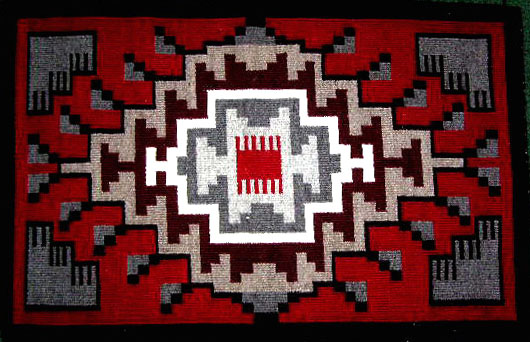 Southwestern art, clothing, home furnishings, rugs, and pottery set the area apart from any other region of the United States. Few other locations rival the number and quality of art galleries found in Santa Fe, and shops featuring Indian crafts, jewelry and pottery seem inexhaustible. Not the least on the scale of Santa Fe’s appeal are the many superb restaurants serving the extraordinary New Mexico style Mexican food.
The next stop in our quest to learn about native American life, history and crafts is the Indian Pueblo Cultural Center in Albuquerque. We will start there in the next installment, “Navajo Country Part II.”
Before leaving Santa Fe, there are other outstanding destinations only a short distance away that are worthy of an additional day or two in the city.
Chimayo, Los Alamos, and Bandelier National Monument
Chimayo
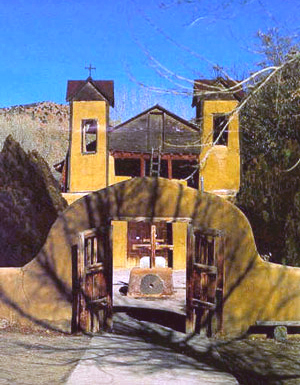 Located about 25 miles north of Santa Fe is the little village of Chimayo. To say it is off the beaten path is geographically accurate, but about 30,0001 Roman Catholic pilgrims a year who visit El Santuario de Chimayó, the small church in the village, which claims to be the most important pilgrimage site in America.
There are several legends of the origin of the alleged miracles associated with the church. Among them is that there was once a hot spring there revered by the local Indians. Now there is a small round pit in one room of the church containing “holy dirt.” I watched as one Hispanic mother rubbed the dirt on the legs and arms of her small children. They did not appear to be sick or handicapped, so she was not hoping for a healing miracle. The ritual may have been performed in the belief that this might immunize them. Pilgrims also take some of the dirt home with them, making it necessary to replace the dirt almost daily. Twenty five to thirty tons of dirt are taken away each year.
1 One source said 30,000 visitors a year, another declared that 300,000 pilgrims visit the church each year.
Most people find the Rancho de Chimayo Restaurante on Juan Medina Road, one of the best dining experiences in the Santa Fe area. Located in a century old adobe home, the authentic native New Mexican cuisine is extraordinary.
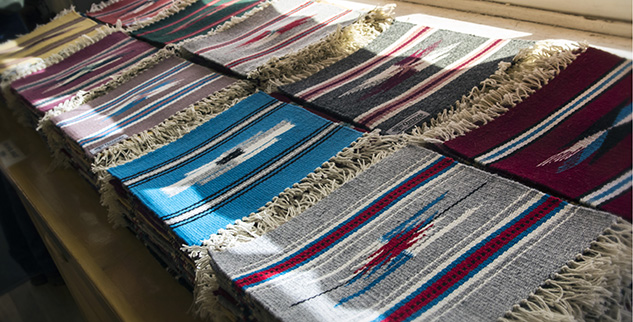 It is obvious from the throw rugs, place mats and woven coasters in our home, that we love Ortega Weavers, located at CR 98 at NM 76 in Chimayo. The colorful indigenous designs add bright accents to any home. I especially enjoyed watching the weavers at work on the looms in the showroom.
https://en.wikipedia.org/wiki/El_Santuario_de_Chimayo
Los Alamos
Los Alamos is a short twenty five mile drive north of Santa Fe. The Los Alamos National Laboratory was established in 1943 for the sole purpose of developing the atomic bomb. Named the Manhattan Project, the first atomic bomb was detonated less than two years later at a test site 100 miles south. The work of the laboratory continues, but the focus now is on scientific solutions related to national security.
Visitors may visit the museum that is divided into Defense, History, Research and Tech Lab galleries which have about 40 interactive exhibits tracing the history of the WWII Manhattan Project to present research. These exhibits together with extensive educational and community programs draw nearly 80,000 visitors a year.
http://lanl.gov/about/history-innovation/index.php
http://www.lanl.gov/museum/visit/about-museum.php
Bandelier National Monument
Fifteen miles down the scenic highway 501 from Los Alamos are the ruins of Indian cliff dwellers at Bandelier. Many of these ruins in Frijoles Canyon have been excavated, studied and preserved.
The main loop trail from the visitor center passes by several types of restored dwellings: communal stone structures along the canyon floor, “cliff houses” built of stone and mud backed against the canyon wall, and “cave dwellings” in holes in the volcanic tuff of the canyon wall. Other archaeological features typical of the Puebloans are the religious structures known as kivas. These are circular, half-buried structures that in Puebloan times would have had flat roofs and entrance ways. Most kivas were perhaps 15 feet in diameter, but many villages were built around a “great kiva” that was much larger. An example of a great kiva has been restored in Frijoles Canyon. Today’s pueblos along the Rio Grande river still use kivas in ceremonies.
 Norman and Jan Rodgers