
A summary of the life of Billy the Kid is told below, based upon the narrative by Marcelle Brothers. The story is an intriguing series of narrow escapes, misfortunes, and adventures. I have included it here because the telling of it became an integral aspect of our itinerary through Navajo Country. Each morning on the motor coach, I related to the passengers another episode in his life, concluding with a cliff-hanger, an easy task considering that Billy always seemed to be coasting on the cusp of crisis. NR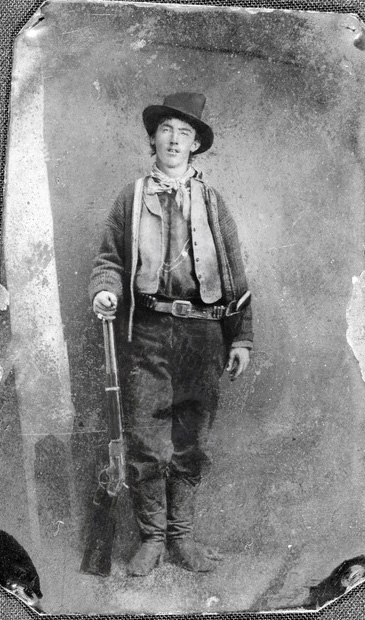
Fort Sumner is a landmark for a reason other than Bosque Redondo, the disastrous relocation site for the Navajo when they were driven from their sacred lands. It is the burial place of Billy the Kid. This small-time horse thief and gunslinger became one of the most famous outlaw legends in American history. A little museum on the highway going through the town is not a bad visit. The Authentic Life of Billy the Kid, by Pat Garrett, the man who killed Billy, is a revealing biography. Ms Brothers version is less self-serving and more objective.
Difficult Childhood
William Henry McCarty was born in Anderson, Indiana or New York City somewhere between 1859 and 1861. His mother, Catherine McCarty married William Antrim, and moved at least three times in as many years. They got married in Santa Fe and finally ended up in Silver City, New Mexico. Billy’s mother died of cancer when he is about 13 or 14. Antrim moved to Arizona leaving Billy and his brother, Joseph, behind to bounce from foster home to foster home. A year later Billy was arrested for stealing laundry, but he escaped and make it to his step-father’s home in Arizona. Antrim did not let him stay, so Billy was now on his own when he was fifteen or sixteen years old at the most.
In 1777 he met a horse thief who convinced him that stealing was easier money than working as a cook. A few months later both were arrested, but Billy escaped that night. Later that summer a bully named, “Windy” Cahill, attacked Billy during an argument. Billy killed him in the fight and high-tailed out of Arizona and back to New Mexico where he joined Jesse Evans, the leader of a gang of rustlers and killers called, “The Boys.”
The Lincoln County War
Ranchers James Dolan and John Tunstall both had the same objective – to form a monopoly in Lincoln County, New Mexico. The Murphy and Dolan company was well established. Dolan had considerable power in the county with sheriff Brady in his picket and a small army of criminals and low-lifes including “The Boys” to protect him from his enemies, but he was also in financial trouble and on the verge of bankruptcy. Along came newcomer John Tunstall, bankrolled by his father back in England.
Billy’s relationship with “The Boys” was becoming contentious and they kicked him out of camp. Shortly afterward Billy was arrested for stealing some of Tunstall’s horses. Instead of pressing charges, Tunstall hired him. Billy was now seventeen years old. He was hopeful that this was his chance for a new start, and he reinvented himself as William Bonney.
Billy was popular in the community because of his humor and gentlemanly deportment. The Mexican girls swarmed around him. He spoke their language and fit in with their ways. He had many admirers although he was always heavily armed.
As Tunstall gained strength, he because more and more a threat to Dolan’s control of the county. Every underhanded effort to get rid of him had failed. With the assistance of the sheriff, he hatched a scheme to arrest Alex McSween, Tunstall’s attorney and partner, on trumped up charges of embezzlement. Sheriff Brady sent a posse of deputies and outlaws to attach Tunstall’s cattle in the embezzlement scam. Tunstall allowed them to take the cattle, but not the horses. He and a handful of men herded the horses into Lincoln. Part of the posse, including some of The Boys pursued Tunstall.
Billy and John Middleton followed about 300 yards behind the herd. Tunstall and two of his men led the way. The men with Tunstall rode off in pursuit of a flock of wild turkeys leaving Tunstall alone. About that time, Billy saw the posse galloping toward them. He and Middleton spurred their horses to reach Tunstall, yelling for him to follow them and take cover, but it was too late. The posse shot and killed Tunstall in cold blood.
The next day the Kid and Dick Brewer, one of the men who chased the turkeys, swore out affidavits with Justice of the Peace Wilson, who then issued warrants against the assassins. Constable Martinez deputized Billy and Fred Waite to arrest the men, who were at Dolan’s store. When the men arrived they found Sheriff Brady present. The sheriff refused the arrest of his men and instead took Martinez and his men prisoner. Their weapons were confiscated and the three men were cursed and abused. They were released two days later.
Justice Wilson deputized Brewer who formed his own posse and named them the “Regulators.” This group included Billy the Kid. Frustrated by the corruption of Sheriff Brady and the refusal of the governor to do anything about the situation, the Regulators concluded that a lawful solution to the problem was impossible. Two of the posse that killed John Tunstall surrendered to the Regulators and were subsequently killed. Six of the Regulators, including the Kid, ambushed and killed Sheriff Brady and a deputy. One of Dolan’s men killed Brewer, but was then killed.
Dolan sought and received help from the army at Fort Stanton. This group cornered the Kid and several of the Regulators at Alex McSween’s house. After a five-day siege, the men under Billy’s leadership hatched a plan. Billy and four of the men were to make a break and run for Tunstall’s store drawing the fire of Dolan’s men and the soldiers. While they were distracted, McSween and the rest were to escape through the back gate in the dark and head for the river.
Around 9:00 pm they executed the plan. By this time the house was on fire, lighting the fleeing men. The Kid and his group met fire from Tunstall’s store and had to change direction and head for the river. McSween and his group also drew considerable fire. After the shooting, McSween and four others were dead. One of Dolan’s men was killed and Billy was blamed for his death even though he was fleeing in another direction and nowhere near the man. The victors got drunk and looted Tunstall’s store. Meanwhile Billy and the surviving Regulators slipped away.
Billy had hoped for a brighter future when he joined with Tunstall, instead he became the scapegoat for the senseless Lincoln County war and was the only one punished. From here on out, he was a fugitive from the law.
On the Run
After lying low for a couple of weeks, Billy and the Regulators rode to the Mescalero Indian Reservation. Some of the party rode ahead while the Kid and others stopped to water their horses. The group that had continued down the road encountered some of the Indians, who opened fire assuming the Mexicans were there to steal horses. Two men from the Indian Agency office rode to investigate and one of them was killed. Again Billy was blamed for a killing when he was not even present.
The Regulators rode north to Fort Sumner, which became their new home. Here they spent their time carousing, dancing and courting the ladies. As time passed they became restless and returned to Lincoln where they harassed and intimidated their enemies. Making off with a herd of horses, they drove them to Tascosa in the Texas panhandle.
The Kid was tired of running and eager to get square with the law. He found the opportunity to do so with the new governor, Lew Wallace. Dolan and his accomplices had killed Mrs. McSween’s attorney while the Kid was forced to watch. The governor was incensed. Billy offered to testify in return for pardon. Wallace agreed. The Kid and his long-time companion, Tom O’Folliard, submitted to a fake arrest and were confined in a local store. The governor interviewed Billy, who told him everything he wanted to know. The trial judge for Mrs. McSween’s attorney’s assassins and the prosecuting attorney were Dolan’s men so the defendants were acquitted. The governor reneged on his promise to the Kid, and left him hung out to dry and in custody with his enemies determined to get even for his testimony against the lawyer’s killers. The guards assigned to Billy and Tom understood the trap and looked the other way when the two walked out and left the store where they were held. Again, hopes of beginning again and a new life were thwarted and Billy was back to being a fugitive.
The two men sought refuge back in Fort Sumner with friends. Feeling like he had no choice, the Kid returned to rustling cattle to get money. He knew that settling down to live an honest life was probably impossible with the law and his enemies both after him. He believe that John Chisum owed him wages from back in Lincoln county. Chisum disagreed, so Billy took his wages out in stolen cattle.
The Kid was involved in another murder. He was drinking with Joe Chisum (John’s brother) and a couple of his cowboys. A drunken bully, Joe Grant, was also in the saloon being totally obnoxious and threatening to kill someone. Grant stole the pistol of one of the cowboys replacing it with his own. The cowboy was smart enough to know that to protest to the drunk might cause him his life. The Kid pretending to admire the cowboy’s pearl-handled pistol that Grant had taken, spun the cylinder so that the next time it was fired, the hammer would hit on an empty chamber. As Billy left the saloon, Grant pulled the pistol and fired it at Billy, but there was only a click. Billy whirled and returned fire, killing Grant. No charges were filed, chalking it up to a barroom brawl.
A hundred and thirty years ago the power of the press to manipulate public opinion was no different from today. Newspapers began describing Billy the Kid as a much more dangerous and desperate outlaw than facts warranted. They greatly increased his notoriety.
Billy tried once more to reverse his status as a fugitive. He wrote to an attorney in Lincoln who had assisted him in the past, begging for help. The lawyer agreed to meet Billy in the White Oaks community of Lincoln county. When Billy arrived six weeks later than he was supposed to, the lawyer was not there. Billy heard that he was in Lincoln, so he and his gang stocked up on supplies and left town without paying. A posse pursued and caught them, but the gang escaped. A few days later the men were caught again. This time another man was killed.
Captured and Tried
The Kid decided that his situation was hopeless. He and his gang headed for Fort Sumner for supplies and then they planned to leave New Mexico for good. Pat Garrett had been elected sheriff of Lincoln county and had ambitions of gaining fame of his own by capturing the state’s most notorious gangster.
In Fort Sumner, Billy and his four men were staying at a ranch some distance out of town. Garrett set a trap for him. He sent an anonymous note to the ranch to inform the gang that Garrett’s posse had left for Roswell, but Garrett was actually waiting to ambush them in Fort Sumner. As Billy and his bunch approached the town, the posse opened fire, aiming at the lead man in the group. It was Tom O’Folliard, the Kid’s long time best friend. Tom was killed. The rest of the gang escaped and returned to the ranch.
A few days later Garrett and his men caught up with the gang again, this time surrounding them in a house, satisfied with a siege. One of the Kid’s gang was killed when he went outside the house. Trapped and starving, Billy’s men couldn’t resist the smell of meat cooking over the fire that the posse made and gave themselves up. Prisoners and lawmen shared a hearty meal. The next morning the entire party rode to Fort Sumner to a blacksmith to make shackles for the prisoners. A day later they were loaded onto a wagon and taken to jail in Las Vegas, New Mexico.
A large crowd gathered outside the jail to gawk while a press conference of sorts took place. The Kid was talkative and laughed when a reporter explained to him how the press had blown his desperado image out of proportion. Billy’s men echoed his claim that he was not at all like his reputation pictured him.
A train transported the prisoners to Santa Fe and the Kid began his campaign to get free. First, they tried to escape, but that did not work. Billy was moved to a solitary cell and chained to the wall. Next he tried enlisting the help of lawyers who knew him. That did not work either. In desperation he wrote to the governor reminding him of reneging on his end of the bargain in Lincoln county while Billy risked his live to live up to his commitment. The governor was having no part of this appeal. The Kid had become much too notorious for a pardon. Back to the beginning, escape attempt became a last resort. No chance.
By now nearly four months had passed, and in March, 1881, Billy the Kid was taken back to Lincoln county to stand trial for the murders of Sheriff Brady and one of the sheriff’s men, Buckshot Roberts. The judge was aware that sentiment in the town favored Billy, so he moved the trial to another location more hostile to the defendant. The Kid’s attorney, Ira Leonard, got the case for killing Roberts thrown out of court. Angry that Leonard was defending the Kid too well, the judge replaced him with two incompetents to insure that there would be no acquittal. With the judge, attorneys, lying witnesses and a jury all stacked against him, Billy stood no chance. Even though he was one of six involved in the shooting, he was the only one indicted. The judges charge to the jury left no doubt about the verdict they were to bring. The jury returned a guilty verdict and Billy the Kid was sentenced to be hung. The guards assigned to escort him back to Lincoln were his most hated enemies, who taunted him trying to provoke him to do something that would be an excuse to shoot him. One of the men, Bob Olinger, had sworn to kill the Kid, and the Kid made no secret of wanting to kill Olinger for gunning down a friend of Billy’s in cold blood. The Kid remained calm and unruffled during the whole ordeal riding back to Lincoln.
Having no suitable jail, the Kid was confined in an upstairs room in the Lincoln county courthouse. He was handcuffed and shackled and Olinger and James Bell were assigned to be in his room at all times.
About a week after the Kid’s arrival, sheriff Garrett left town to collect taxes. Olinger and Bell were the only lawmen left in town. All the prisoners other than Billy were escorted daily across the street to the Wortley hotel for meals. That day it was Orlinger’s turn to take them to lunch. The Kid realized this might be his only chance. Bell was easy-going and did not have the intense hatred for Billy that Olinger possessed.
Probably when Bell’s attention was averted, the Kid slipped his small hand out of one of the handcuffs, hit Bell over the head and stole his pistol. Instead of surrendering as the Kid demanded, Bell turned and ran down the stairs. Billy had no choice but to shoot him to prevent him from spreading the alarm. At the hotel across the street, Olinger heard the shot and hurried outside. From his upstairs window, the Kid shouted, “Hello Bob.”
“He just killed Bell,” the courthouse groundskeeper called out to Olinger.
“Yes, and he just killed me,” Olinger responded just as the Kid shot his hated enemy with both barrels of Olinger’s shotgun.
The Kid seemed in no hurry. From the upstairs window he instructed the groundskeeper to toss him a small pick lying on the ground nearby and to saddle a horse for him. With the pick Billy broke one of the leg shackles. He then walked out on the upstairs balcony and addressed the gathering group of locals across the street telling them that he did not want to kill Bell, but had to because he was running away. He continued speaking to the people warning them not to try to stop him. He did not want to hurt anyone, he said, but he would if necessary. Billy gathered up guns, exited the back door, as he passed Bell’s body he apologized to him reiterating that he had not wanted to shoot him, but did not have a choice.
End of the Trail
On his way out of town, the Kid visited some of his friends to tell them his side of the escape story and informing them that he was going back to Fort Sumner. For several months he hung out in several locations around the town, seemingly not concerned about sheriff Garrett finding him. Someone, possibly the brother of one of Billy’s girlfriends got word to Garrett that the Kid was in the Fort Sumner area. The sheriff quietly went there with the intention of killing the Kid, not even attempting to take him alive.
The Kid visited with friends and sweethearts oblivious that Garrett was in the vicinity. One night when most everyone had gone to bed, sheriff went to Pete Maxwell’s house on the Plaza to inquire if he had seen the Kid, walking in a side door and into the bedroom, he awakened Maxwell. At the same time the host where Billy was staying announced that Maxwell had butchered a yearling that day and they were welcome to have some of it. Billy grabbed a butcher knife and walked across the plaza to Maxwell’s house, almost bumping into the two men Garrett had stationed outside.
Garrett’s version of what happened next may or may not be accurate, for he was eager to make himself out to be a hero. In his book, he says that Billy entered Maxwell’s bedroom and leaning over, inquired about the two men outside. Maxwell whispered to Garrett, “It’s him.” The Kid then became aware of another person in the room, and may have realized that it was Garrett. The sheriff fatally shot the Kid in the chest. Garrett and Maxwell fled the room and waited to make sure Billy was dead.
By this time people in the surrounding homes had come out to find out what the shots were about. When they learned that the Kid was dead, some of the men shouted angrily at Garrett and many of the women cried. Billy was a popular person in town. The next day Billy the Kid was buried outside Fort Sumner next to his long-time friends, Tom O’Folliard and Charlie Bowdre. He was 19 or 20 years old when he died. On his tombstone is the inscription:
BILLY THE KID
Born Nov 23 1860 Killed Jul 14 1881
THE BOY BANDIT KING HE DIED AS HE HAD LIVED
http://www.aboutbillythekid.com/
http://www.billythekidmuseumfortsumner.com/
 Norman and Jan Rodgers